
Collagen Peptides vs Powder: Which One Should You Take?
Confused about whether to buy collagen peptides or collagen powder? You’re not alone. These terms get used interchangeably on supplement labels, yet they can mean slightly different things depending on how the product is made. This guide breaks down what each one actually is, how they compare on absorption and benefits, and how to pick the right option for your skin, joints, and overall goals—all without the marketing hype.
Quick answer: Collagen peptides and collagen powder often refer to the same thing. Most collagen powders sold today are hydrolyzed collagen peptides in powdered form. The real difference comes down to whether the collagen has been hydrolyzed (broken into smaller peptides for easier absorption) and which type of collagen the product contains—not the powder format itself.
Key Takeaways
- Collagen peptides are collagen that has been hydrolyzed (broken down) into short chains of amino acids for better absorption. They usually come as a powder.
- Collagen powder is a broad term. It can mean hydrolyzed peptides, gelatin, or undenatured collagen—so the label matters more than the word “powder.”
- Hydrolyzed collagen peptides tend to dissolve easily in hot or cold liquids and are highly bioavailable, meaning your body absorbs them efficiently.
- For skin, hair, and nails, type I collagen peptides are the most studied. For joints, type II collagen is often preferred.
- Both formats are generally safe for most healthy adults, but it’s smart to check the source, type, and third-party testing before buying.
What Is Collagen?
Collagen is the most abundant protein in the human body, making up roughly 30% of your total protein, according to the National Institutes of Health. It acts as the structural “glue” that holds together your skin, bones, tendons, ligaments, and muscles.
Your body produces collagen naturally, but production starts to decline in your mid-20s and drops more sharply after menopause and with age. This decline is linked to common signs of aging such as wrinkles, joint stiffness, and reduced skin elasticity.
There are at least 28 known types of collagen, but a few matter most for supplements:
- Type I: Found in skin, bones, tendons, and ligaments. The most common type in the body.
- Type II: Found in cartilage. Often targeted for joint support.
- Type III: Found in skin, muscles, and blood vessels. Frequently paired with type I.
What Are Collagen Peptides?
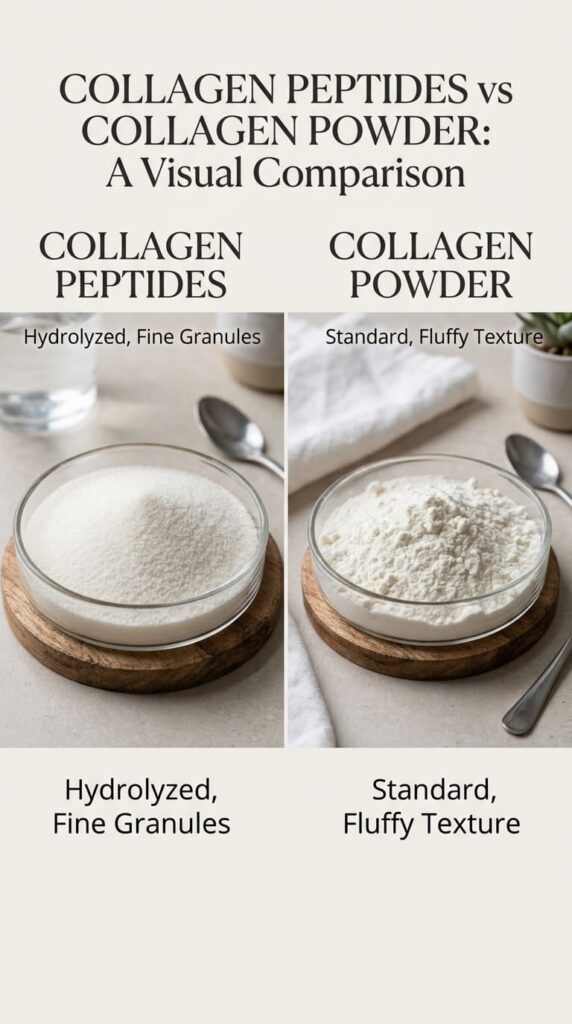
Collagen peptides are collagen molecules that have been hydrolyzed—broken down into shorter chains of amino acids through a process using water and enzymes. This makes the peptides smaller, easier to digest, and quick to dissolve in liquids.
Because of their small molecular size, collagen peptides are considered highly bioavailable. They typically:
- Dissolve in both hot and cold liquids without clumping
- Have little to no taste or odor
- Come almost always in powder form (sometimes in capsules or liquid)
You’ll often see collagen peptides labeled as “hydrolyzed collagen” or “collagen hydrolysate.” These three terms generally describe the same product.
What Is Collagen Powder?
Collagen powder is simply collagen sold in a dry, powdered format. The key thing to understand: “collagen powder” describes the form, not the type or processing level. A tub labeled collagen powder could contain any of the following:
- Hydrolyzed collagen peptides – the most common and easiest to mix
- Gelatin – partially hydrolyzed collagen that gels when cooled (think jelly)
- Undenatured type II collagen – minimally processed, often used for joint formulas in small doses
So when someone compares “peptides vs powder,” they’re usually comparing hydrolyzed collagen peptides against other powdered forms like gelatin—or simply unsure that most powders already are peptides.
Collagen Peptides vs Collagen Powder: Key Differences
Here’s a side-by-side look at how the formats typically compare:
|
Feature |
Collagen Peptides |
Collagen Powder (general) |
|---|---|---|
|
Processing |
Fully hydrolyzed |
Varies (hydrolyzed, gelatin, or undenatured) |
|
Solubility |
Dissolves in hot or cold liquids |
Depends on type; gelatin only dissolves in heat |
|
Texture when cooled |
Stays liquid |
Gelatin will gel/thicken |
|
Absorption |
High (small peptides) |
Varies by type |
|
Taste |
Usually neutral |
Varies |
|
Best for |
Daily drinks, smoothies, coffee |
Cooking, baking, recipes (gelatin), targeted joint use (type II) |
The takeaway: if your “collagen powder” lists hydrolyzed collagen or collagen peptides as the ingredient, you’re already getting peptides. If it lists gelatin, you have a different, partially hydrolyzed product that behaves differently in recipes.
Benefits of Collagen Peptides
Collagen peptides are the most researched collagen format. Studies have explored several potential benefits, though results vary and more research is ongoing.
- Skin elasticity and hydration: A 2019 review in the Journal of Drugs in Dermatology found that oral collagen supplements may support skin elasticity and hydration.
- Easy daily use: Their neutral taste and cold-water solubility make them simple to add to coffee, water, or smoothies.
- Protein content: A typical scoop provides around 10–20 grams of protein from amino acids like glycine, proline, and hydroxyproline.
- Convenience: No cooking or special preparation required.
Benefits of Collagen Powder
The benefits of collagen powder depend entirely on which type it contains. Gelatin and undenatured collagen each offer their own advantages:
- Gelatin for cooking: Its gelling property makes it ideal for homemade gummies, soups, broths, and desserts.
- Gut-friendly reputation: Gelatin is often favored in traditional cooking and broths for its texture and amino acid profile.
- Undenatured type II collagen for joints: Some research suggests small daily doses (around 40 mg) of undenatured type II collagen may support joint comfort, though more studies are needed.
- Versatility: Powders let you control dosage and mix into a wide range of foods and drinks.
Which Is Better for Skin, Hair, and Nails?
For skin, hair, and nails, hydrolyzed collagen peptides containing type I (and often type III) collagen are generally the better choice. Their small peptide size supports efficient absorption, and most clinical research on skin benefits has used hydrolyzed peptides rather than gelatin.
A 2021 systematic review in the International Journal of Dermatology examined 19 studies and reported that hydrolyzed collagen supplementation showed promising results for skin hydration and elasticity. Marine collagen peptides, which are rich in type I, are a popular option for this purpose.
Choose peptides if your main goal is skin, hair, or nail support and you want an easy daily routine.
Which Is Better for Joints and Bone Health?
For joints, the answer depends on the collagen type rather than the powder format:
- Type II collagen (often undenatured) is most associated with cartilage and joint support.
- Hydrolyzed type I and III peptides may also support bone health, as some studies suggest a link between collagen peptides and bone mineral density in postmenopausal women.
A 2018 study in Nutrients found that specific collagen peptides improved bone mineral density in postmenopausal women over 12 months. For cartilage-specific support, however, products featuring undenatured type II collagen are commonly recommended.
Choose type II collagen if joint cartilage is your priority. Choose type I/III peptides for broader bone and structural support.
Als You can read This if you want: Behavioral Health Technician: Role, Skills & Salary Guide
Absorption and Bioavailability Comparison
Hydrolyzed collagen peptides win on absorption. Because hydrolysis breaks collagen into small peptides (often under 5,000 daltons), your digestive system can absorb them more readily than larger, intact collagen molecules.
|
Form |
Molecular Size |
Bioavailability |
Notes |
|---|---|---|---|
|
Hydrolyzed peptides |
Small |
High |
Absorbed efficiently; dissolves easily |
|
Gelatin |
Medium |
Moderate |
Partially broken down; gels when cool |
|
Undenatured collagen |
Large/intact |
Works differently |
Used in tiny doses for immune-mediated joint effects |
Research published in the Journal of Agricultural and Food Chemistry has shown that collagen peptides can be detected in the bloodstream after ingestion, suggesting effective absorption. Undenatured type II collagen is thought to work through a different mechanism involving the immune system, not standard amino acid absorption—which is why it’s used in much smaller amounts.
Side Effects and Safety Considerations
Collagen supplements are generally considered safe for most healthy adults, and serious side effects are rare. That said, keep these points in mind:
- Mild digestive effects: Some people report bloating, fullness, or a mild aftertaste.
- Allergens: Marine collagen may trigger fish or shellfish allergies. Bovine collagen comes from cattle. Always check the source.
- Purity concerns: Because supplements aren’t tightly regulated, choose products with third-party testing (such as NSF or Informed Sport).
- Special situations: If you’re pregnant, breastfeeding, or managing a health condition, talk to a healthcare provider before starting any supplement.
This article is for general information only and is not medical advice.
How to Choose the Right Collagen Supplement
Use this checklist to find a product that matches your goals:
- Match the type to your goal. Type I/III for skin and general support; type II for cartilage and joints.
- Confirm it’s hydrolyzed if you want easy mixing and high absorption—look for “hydrolyzed collagen” or “collagen peptides” on the label.
- Check the source. Bovine, marine, porcine, or chicken—pick based on dietary preferences and allergies.
- Look for third-party testing to verify purity and quality.
- Review the dosage. Many skin studies used 2.5–10 grams of peptides daily; joint studies with undenatured type II used about 40 mg daily.
- Keep the ingredient list short. Minimal additives, fillers, and artificial sweeteners are ideal.
- Consider added nutrients. Vitamin C supports your body’s natural collagen synthesis and is sometimes included.
Frequently Asked Questions
Are collagen peptides and collagen powder the same thing?
Often, yes. Most collagen powders on the market are hydrolyzed collagen peptides in powder form. The difference only appears when a “powder” is actually gelatin or undenatured collagen, which are processed differently and behave differently in recipes.
Which is better absorbed, peptides or powder?
Hydrolyzed collagen peptides are better absorbed than gelatin or intact collagen because hydrolysis breaks them into smaller, more bioavailable pieces. If your collagen powder is already hydrolyzed, its absorption is the same as peptides.
Can I use collagen peptides in hot coffee?
Yes. Hydrolyzed collagen peptides dissolve in both hot and cold liquids without clumping or gelling, which makes them ideal for coffee, tea, smoothies, and water.
What’s the best collagen type for skin?
Type I collagen, often combined with type III, is the most studied for skin elasticity and hydration. Marine collagen is a rich source of type I and a popular choice for skin-focused goals.
How much collagen should I take per day?
Dosage depends on your goal and the product. Many skin and bone studies used 2.5–10 grams of hydrolyzed peptides daily, while undenatured type II collagen for joints is typically used at around 40 mg per day. Follow the product label and consult a healthcare provider for personalized advice.
Are there any side effects of taking collagen?
Side effects are uncommon and usually mild, such as bloating or a slight aftertaste. People with fish or shellfish allergies should avoid marine collagen. Choose third-party tested products to ensure quality.
Is gelatin or hydrolyzed collagen better?
It depends on use. Gelatin is great for cooking and recipes that need a gel, like homemade gummies and broths. Hydrolyzed collagen peptides are better for daily drinks and convenience because they dissolve easily and absorb well.
The Bottom Line on Peptides vs Powder
The “peptides vs powder” debate is mostly a misunderstanding—most collagen powders already are hydrolyzed peptides. What truly matters is the collagen type (type I/III for skin, type II for joints), whether it’s hydrolyzed for easy absorption, and the quality and source of the product.
If you want a simple daily supplement for skin, hair, and nails, reach for hydrolyzed collagen peptides with type I and III. If joint cartilage is your focus, look into undenatured type II collagen. And if you love to cook, gelatin powder has a place in your kitchen.
Next step: read the ingredient label on any collagen product before you buy, match the type to your personal goals, and check for third-party testing. When in doubt, a quick conversation with your healthcare provider can help you choose with confidence.
Leave a Reply