
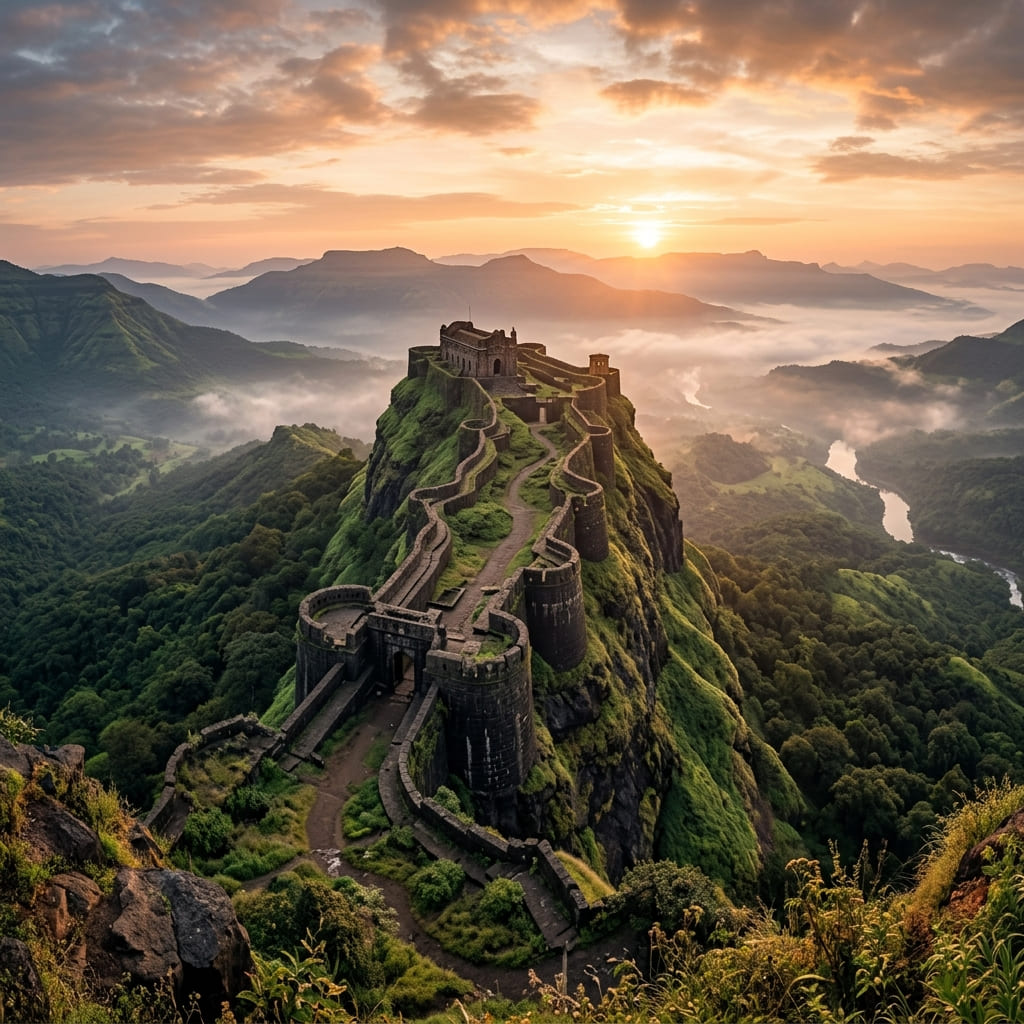
15 Most Famous Forts in Maharashtra: The Complete Travel Guide
Maharashtra stands apart from every other state in India when it comes to fortified heritage. With more than 350 forts scattered across its rugged Sahyadri mountains, Konkan coastline, and Deccan plateau, the state holds a military and cultural legacy unlike anything else on the subcontinent. This guide covers the 15 most famous Maharashtra forts their history, architecture, trekking difficulty, best time to visit, and what makes each one worth the journey.
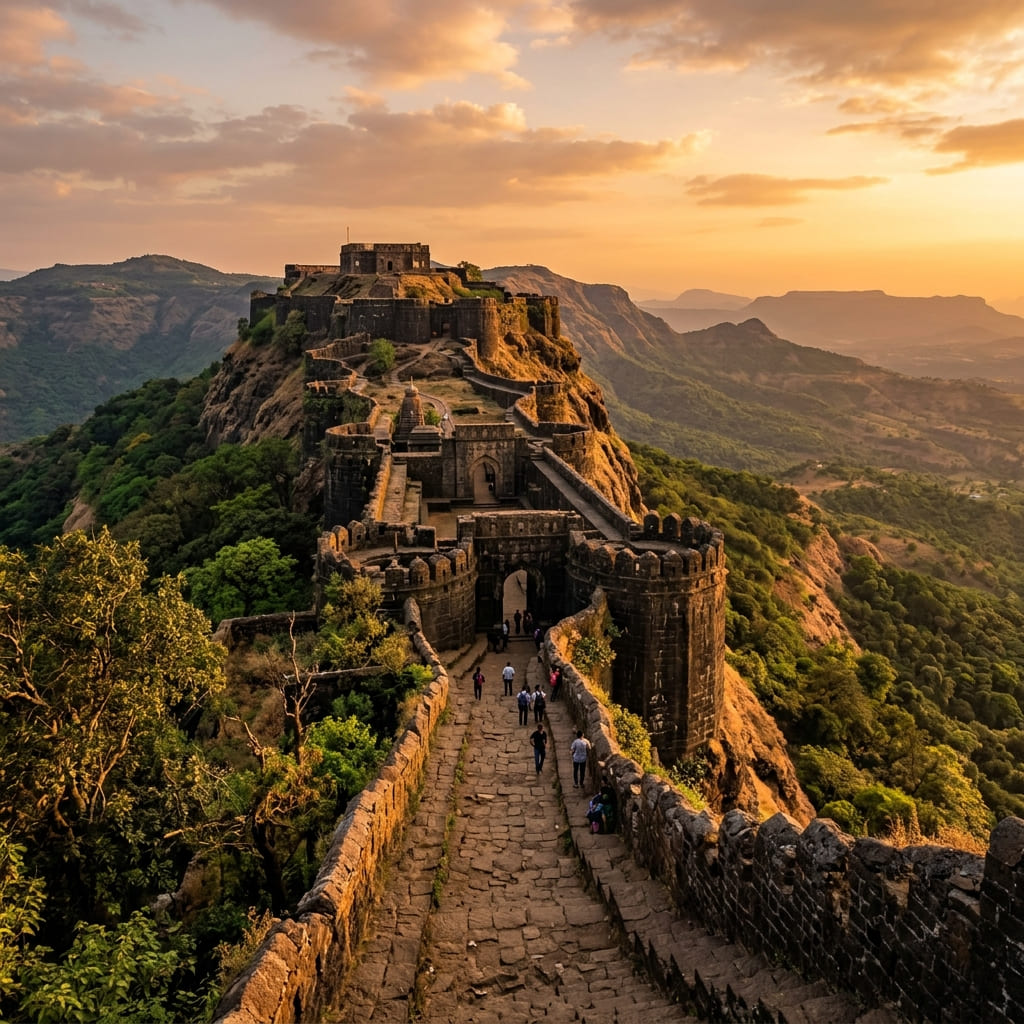
Key Takeaways
- Maharashtra has more than 350 forts, more than any other Indian state, and 11 of them are recognized as UNESCO World Heritage Sites under the “Maratha Military Landscapes of India.”
- Chhatrapati Shivaji Maharaj built, captured, or used dozens of these forts as the strategic backbone of the Maratha Empire in the 17th century.
- Maharashtra forts fall into four categories: hill forts (giri durg), sea forts (jal durg), forest forts (van durg), and land forts (bhu durg).
- The best time to visit most hill forts is October to March; sea forts and monsoon treks are best enjoyed between June and September.
- Whether you’re a history enthusiast, an adventure trekker, or a weekend traveler, Maharashtra’s fort circuit offers something at every level of difficulty.
The History of Maharashtra Forts
The fort-building tradition in Maharashtra spans nearly 2,000 years. Early fortifications date back to the Satavahana and Rashtrakuta dynasties, but the most significant period of construction came during the Yadava dynasty (12th–14th centuries) and then under the Maratha Empire in the 17th century.
When Chhatrapati Shivaji Maharaj rose to power, he transformed the forts of the Sahyadri range into a sophisticated military network. He captured his first fort—Torna—at just 16 years of age in 1646. By the time of his coronation at Raigad Fort in 1674, he had built, captured, or renovated dozens of strategic strongholds. These forts weren’t merely defensive structures. They were administrative centers, treasury vaults, and symbols of sovereignty.
After the decline of the Maratha Empire, many forts passed into the hands of the British East India Company and were either repurposed or left to ruin. Today, they stand as protected monuments—some well-preserved, others crumbling—each carrying centuries of layered history within their walls.
Why Is Maharashtra Called the Land of Forts?
Maharashtra earns this title for several reasons. First, sheer volume: more than 350 forts exist across the state. Second, strategic diversity: the forts include sea forts built to control Konkan trade routes, mountain forts perched on Sahyadri peaks, and plateau forts commanding Deccan trade corridors. Third, historical depth: these structures were at the center of events that shaped Indian history—from the rise of the Maratha Empire to resistance against Mughal expansion.
In 2024, UNESCO inscribed the “Maratha Military Landscapes of India” as a World Heritage Site, recognizing 11 forts in Maharashtra plus one in Tamil Nadu for their outstanding universal value. That recognition placed Maharashtra’s fort heritage firmly on the world map.
Top 15 Famous Forts in Maharashtra
Quick Comparison Table
|
Fort |
District |
Elevation |
Type |
Trek Difficulty |
Best Time |
|---|---|---|---|---|---|
|
Raigad |
Raigad |
1,356 m |
Hill |
Ropeway / Steps |
Oct–Mar |
|
Sinhagad |
Pune |
1,320 m |
Hill |
Easy–Moderate |
Jun–Sep |
|
Pratapgad |
Satara |
1,080 m |
Hill |
Easy |
Oct–Mar |
|
Shivneri |
Pune |
~1,000 m |
Hill |
Moderate |
Oct–Mar |
|
Rajgad |
Pune |
1,252 m |
Hill |
Easy–Moderate |
Oct–Mar |
|
Torna |
Pune |
1,403 m |
Hill |
Difficult |
Oct–Mar |
|
Lohagad |
Pune |
1,033 m |
Hill |
Easy–Moderate |
Jun–Sep |
|
Visapur |
Pune |
1,084 m |
Hill |
Moderate |
Jun–Sep |
|
Murud-Janjira |
Raigad |
Sea level |
Sea |
Boat access |
Oct–Mar |
|
Sindhudurg |
Sindhudurg |
Sea level |
Sea |
Boat access |
Oct–Mar |
|
Harishchandragad |
Ahmednagar |
1,424 m |
Hill |
Difficult |
Jun–Sep |
|
Panhala |
Kolhapur |
~851 m |
Hill |
Road accessible |
Oct–Mar |
|
Daulatabad |
Chh. Sambhaji Nagar |
~200 m hill |
Rock |
Walkable steps |
Oct–Mar |
|
Tikona |
Pune |
1,075 m |
Hill |
Easy |
Year-round |
|
Korigad |
Pune |
929 m |
Hill |
Easy |
Jun–Sep |
1. Raigad Fort — The Capital of the Maratha Empire
Raigad Fort served as the capital of the Maratha Empire from 1674 to 1818. Situated at 1,356 meters above sea level in the Sahyadri range, it overlooks the town of Mahad in Raigad district. Chhatrapati Shivaji Maharaj was crowned here in 1674, and the fort remained the administrative and military center of his empire until his death in 1680.
The fort was designed by Hiroji Indulkar and features 1,737 rock-cut steps, multiple gateways, bastions, and the Rajwada (royal palace ruins). Visitors can either climb the steps or take the Raigad Ropeway, which covers 750 meters in just four minutes.
- Visiting hours: 9:00 AM – 5:00 PM
- Best time to visit: October to March
- Highlight: Site of Shivaji Maharaj’s coronation; panoramic views of the Sahyadri range
2. Sinhagad Fort — Where Tanaji’s Legend Lives
Also known as Kondhana Fort, Sinhagad sits approximately 30 kilometers southwest of Pune at an elevation of 1,320 meters. Its history reaches back to the 2nd century BCE, but the event that defined it came in 1670—the Battle of Sinhagad, in which Tanaji Malusare led a daring nighttime assault to recapture the fort from Mughal forces. Tanaji died in the battle; Shivaji Maharaj reportedly said, “The fort is won, but the lion is gone.”
The fort is one of the most visited in Maharashtra, popular for both its history and its accessible trek. The monsoon season transforms the surrounding hills into a lush green panorama.
- Best time to visit: June to September (monsoon)
- Highlight: Samadhi of Tanaji Malusare; Kaundinyeshwar Temple
3. Pratapgad Fort — Site of the Battle That Changed History
Built by Shivaji Maharaj in 1656, Pratapgad Fort sits in Satara district, about 24 kilometers from Mahabaleshwar at 1,080 meters. The fort was the site of the Battle of Pratapgad in 1659, where Shivaji’s forces defeated Bijapur Sultanate general Afzal Khan. That victory established Shivaji as a formidable military force in the Deccan.
The fort houses the Bhavani Temple, constructed by Shivaji himself, as well as the tomb of Afzal Khan and the Pratapgad Museum.
- Best time to visit: October to March
- Highlight: Bhavani Temple; Afzal Khan’s tomb; Pratapgad Museum
4. Shivneri Fort — Birthplace of Chhatrapati Shivaji Maharaj
Shivneri Fort, located near Junnar in Pune district, holds a place of supreme reverence in Marathi culture. Chhatrapati Shivaji Maharaj was born here on February 19, 1630. The fort is triangular in shape, fortified by seven gates, and surrounded by steep cliffs on all sides.
Its history traces back to the 6th century, passing through Maurya, Chalukya, Rashtrakuta, Yadava, and Mughal rule before Shivaji captured it in 1674.
- Best time to visit: October to March
- Highlight: Shivaji’s birthplace chamber with statues of Shivaji and Jijabai; Shivai Devi Temple
5. Rajgad Fort — The First Capital of the Maratha Empire
Before Raigad, there was Rajgad. This fort served as the first capital of the Maratha Empire for approximately 26 years. Located in Pune district at 1,252 meters, Rajgad is one of the most historically significant forts in Maharashtra. Its name translates to “King’s Fort,” and its size—covering a vast plateau with multiple sub-forts (Padmavati Machi, Sanjivani Machi, Balekilla)—reflects its administrative importance.
The trek is classified as easy to moderate, making it accessible for most fitness levels.
- Best time to visit: October to March
- Highlight: Three distinct machis (plateaus); Padmavati Temple; panoramic views of the Sahyadri range
6. Torna Fort — Shivaji’s First Conquest
Torna Fort, also known as Prachandagad, holds the distinction of being the first fort captured by Chhatrapati Shivaji Maharaj, who took it from the Adilshahi Sultanate in 1646 at just 16 years of age. At 1,403 meters, it is the highest hill fort in Pune district. Torna’s height and rugged terrain make it a challenging but rewarding trek.
The ascent begins from Velhe village and involves dense forest trails, rocky outcrops, and a final stretch of rock-cut steps known as the Chakan Path.
- Best time to visit: October to March
- Highlight: Toranjai Temple; Zunjar Machi viewpoint; dramatic Sahyadri scenery
7. Lohagad Fort — The Iron Fort of Lonavala
Lohagad, meaning “Iron Fort,” stands 1,033 meters above sea level near Lonavala, Pune district. Chhatrapati Shivaji Maharaj captured it in 1648, and for a time it served as a treasury for Maratha wealth. Its most iconic feature is the Vinchu Kata—a narrow, scorpion’s-tail-shaped rock formation extending from the main fort.
The trek is moderate in difficulty and takes approximately two to three hours. The monsoon season makes the surrounding hills especially beautiful.
- Best time to visit: June to September
- Highlight: Vinchu Kata; panoramic views of Pavana Lake; accessible from Lonavala
8. Visapur Fort — The Peshwa’s Twin Fort
Visapur Fort was constructed between 1713 and 1720 CE by Balaji Vishwanath, the first Peshwa of the Maratha Empire. Sitting at 1,084 meters in Pune district, it shares a plateau with Lohagad but stands at a higher elevation and covers a larger area. The two forts are often referred to as twin forts.
In 1818, the British used Visapur’s elevated position to bombard Lohagad with cannon fire, forcing the Marathas to retreat. Today, much of Visapur is in ruins, but its walls, cisterns, Peshwa’s palace ruins, and Hanuman carvings remain.
- Best time to visit: June to September (monsoon)
- Highlight: Peshwa’s palace ruins; massive stone walls; rare Maratha-era cannon
9. Murud-Janjira Fort — The Unconquered Sea Fort
Murud-Janjira Fort is one of the most remarkable fortifications in India—an island sea fort that was never conquered, despite repeated attempts by the Marathas, Portuguese, and British. The fort was built and controlled by the Siddi dynasty, a naval force of African descent, with origins dating to the 14th century.
Perched on a rocky islet in the Arabian Sea off the coast of Murud, the fort features oval walls 40 feet high, 19 rounded bastions, and three massive cannons: Kalal Bangadi, Chavri, and Landa Kasam.
Access is by boat from Rajapuri village.
- Best time to visit: October to March (sea can be rough in monsoon)
- Highlight: Never-conquered status; 19 bastions; panoramic Arabian Sea views
10. Sindhudurg Fort — Shivaji’s Naval Stronghold
Sindhudurg Fort was built by Chhatrapati Shivaji Maharaj between 1664 and 1667 on an island off Malvan in the Konkan coast. Spanning 48 acres, the fort was constructed to defend Maratha territory from Portuguese, Dutch, English, and Siddi forces. Its entrance gate (Dilli Darwaja) was strategically hidden from view—an early example of defensive deception.
A unique feature inside the fort is a slab bearing the actual handprints and footprints of Shivaji Maharaj, preserved for over 350 years.
- Visiting hours: 8:00 AM – 5:30 PM
- Best time to visit: October to March
- Highlight: Shivaji Maharaj’s handprints and footprints; Bhavani, Hanuman, and Jarimari temples
11. Harishchandragad Fort — The Trekker’s Challenge
Harishchandragad dates to the 6th century, built during the reign of the Kalachuri dynasty. Towering at approximately 1,424 meters in Ahmednagar district, the fort overlooks Malshej Ghat and offers some of the most dramatic scenery in the Sahyadri range. Its most famous feature is the Konkan Kada—a sheer, overhanging cliff that drops nearly 1,000 feet into the valley below.
Two main trekking routes exist: the Junnar Gate route and the Nalichi Wat route. Both are physically demanding and suitable for experienced trekkers.
- Best time to visit: June to September (monsoon)
- Highlight: Konkan Kada cliff; Kedareshwar Cave; Harishchandra Temple (11th century)
12. Panhala Fort — Where Shivaji Spent 500 Days
Panhala Fort was originally built between 1178 and 1209 CE by Shilahara ruler Bhoja II, 20 kilometers northwest of Kolhapur. Its location—commanding a crucial mountain pass connecting the interior Deccan to the Konkan coast—made it one of the most strategically contested forts in western India. Shivaji Maharaj captured Panhala in 1673 and spent more than 500 days within its walls—more than at any fort other than his childhood homes.
The most famous episode connected to Panhala is the Battle of Pavan Khind in 1660, where Baji Prabhu Deshpande and a small Maratha force held back a far larger Mughal army so Shivaji could escape to Vishalgad.
- Best time to visit: October to March
- Highlight: Three gates (Char Darwaja, Teen Darwaja, Wagh Darwaja); grand palaces; accessible by road
13. Daulatabad Fort — The Fortress That Defied Conquest
Daulatabad Fort, originally known as Deogiri, was built in the 12th century by Bhillama V of the Yadava dynasty. Located 16 kilometers from Aurangabad (now Chhatrapati Sambhaji Nagar), the fort sits atop a 200-meter-high isolated rock. Its architecture is among the most sophisticated of medieval India—a single narrow path carved into the rock, sharp turns designed to slow invaders, iron-spiked gates, a moat believed to have housed crocodiles, and hidden trap doors throughout.
In 1327, Sultan Muhammad bin Tughluq of the Delhi Sultanate relocated his entire capital from Delhi to Daulatabad—an experiment that failed within a few years due to logistical problems, after which the capital was returned to Delhi.
The 64-meter-tall Chand Minar, built by Alauddin Bahman Shah in the 15th century, is the fort’s most visible landmark.
- Best time to visit: October to March
- Highlight: Chand Minar; Andheri Passage (dark labyrinth); Chini Mahal; Baradari Pavilion
14. Tikona Fort — The Triangular Fort by the Backwaters
Tikona, meaning “triangle” in Marathi, is named for its distinctive three-sided shape. Located near Kamshet in Pune district at approximately 1,075 meters, the fort overlooks the scenic Pawna backwaters and is known for being one of the more beginner-friendly treks in Maharashtra.
The trail is well-marked, the climb takes roughly 1.5 to 2 hours, and the summit rewards trekkers with sweeping views of the lake and surrounding Sahyadri hills. Trimbakeshwar Temple at the summit adds a spiritual dimension to the visit.
- Best time to visit: Year-round (especially pleasant October–March and monsoon)
- Highlight: Pawna backwaters view; Trimbakeshwar Temple; beginner-friendly trail
15. Korigad Fort — The Easiest Trek Near Lonavala
Korigad Fort stands at 929 meters near Lonavala in Pune district and is widely regarded as one of the easiest fort treks in Maharashtra. The climb takes roughly one to one and a half hours one way. The fort features two large water tanks, ancient cannon placements, and an old temple.
Korigad is a good starting point for families, first-time trekkers, and those wanting a low-effort introduction to Maharashtra’s fort culture.
- Best time to visit: June to September (monsoon)
- Highlight: Twin water tanks; cannon ruins; suitable for beginners and families
What Is the Best Time to Visit Maharashtra Forts?
The best time to visit Maharashtra forts depends on the type of fort and the experience you’re seeking.
- October to March (Winter): Ideal for most hill forts and all sea forts. Weather is cool and dry, trails are safe, and visibility is excellent. This is the peak season for forts like Raigad, Pratapgad, Daulatabad, Sindhudurg, and Murud-Janjira.
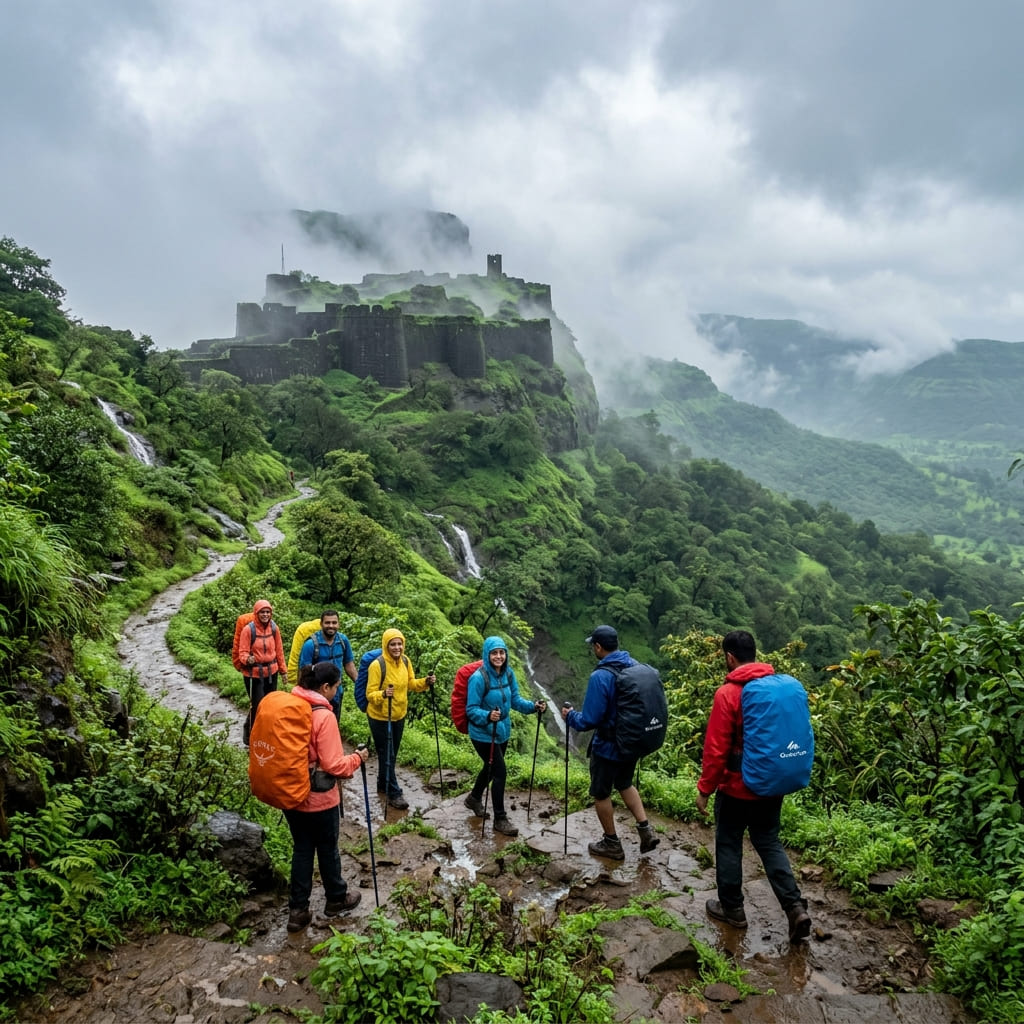
- June to September (Monsoon): The Sahyadri range comes alive with waterfalls and greenery. Forts like Sinhagad, Lohagad, Harishchandragad, and Korigad are spectacular in the rain. Note that trails can be slippery—proper footwear is essential.
- March to May (Summer): The heat makes high-altitude treks uncomfortable, especially at forts like Torna and Harishchandragad. Early morning starts can make summer visits manageable.
Trekking Tips and Safety Guide for Maharashtra Forts
Before setting out for any fort trek in Maharashtra, keep these points in mind:
- Start early. Most trekkers begin before 7:00 AM to avoid afternoon heat and to complete the return journey in daylight.
- Carry enough water. Many forts have ancient cisterns, but they are not always drinkable. Bring at least 2 liters per person.
- Wear sturdy footwear. Rock-cut steps, loose gravel, and monsoon-wet surfaces demand grip-sole shoes or trekking boots.
- Hire a local guide. For complex forts like Harishchandragad, Torna, or Rajgad, a guide prevents wrong turns and adds historical context.
- Check weather forecasts. Monsoon treks carry real risk from flash flooding and lightning. Avoid exposed ridges during storms.
- Respect the monuments. Do not carve into walls, remove artifacts, or litter. These sites are protected monuments.
- Register if required. Some forts in remote areas require prior trekking registration with local authorities.
The Historical Importance of Chhatrapati Shivaji Maharaj’s Forts
Chhatrapati Shivaji Maharaj did not simply occupy forts—he built a strategic intelligence around them. He categorized forts by their terrain type, assigned governors (killedars) to each, maintained resident garrisons, stored supplies for extended sieges, and used an advanced system of signal fires to communicate between hilltops.
The forts were not isolated strongholds. They formed an interconnected network across the Sahyadri range, allowing rapid troop movement and mutual defense. This system enabled the Maratha Empire to resist Mughal expansion under Aurangzeb for decades.
Shivaji’s forts also served social functions: granaries, courts of justice, temples, and treasuries existed within their walls. Raigad Fort alone had 300 houses, a market, a darbar hall, a Rajwada, and water management systems when Shivaji was crowned there in 1674.
In 2024, the UNESCO inscription of the “Maratha Military Landscapes of India” formally acknowledged this network’s exceptional historical significance on a global scale.
A Travel Itinerary for Maharashtra Fort Lovers
Weekend 1 — Pune Fort Circuit (2–3 days)
Pune makes an excellent base. Cover Sinhagad Fort (half day), Lohagad and Visapur (full day, twin trek), and Tikona or Korigad (half day). Add Rajgad or Torna for a more adventurous extension.
Weekend 2 — Raigad and Konkan (2 days)
Drive from Pune to Raigad Fort (ropeway or steps). Spend the second day at Murud-Janjira Fort (boat from Rajapuri). Stay overnight in Murud.
Weekend 3 — Satara and Kolhapur (2–3 days)
Visit Pratapgad Fort (near Mahabaleshwar), then drive south to Panhala Fort near Kolhapur. Combine with Kolhapur’s Mahalaxmi Temple.
Weekend 4 — Harishchandragad and Shivneri (2 days)
Drive through Malshej Ghat to Harishchandragad (reserve this for experienced trekkers). Return via Junnar to visit Shivneri Fort.
Extended Trip — Konkan and Aurangabad
Dedicate a day to Sindhudurg Fort near Malvan. Combine Daulatabad Fort with Ellora Caves and Bibi Ka Maqbara for a full Aurangabad day trip.
Your Gateway to Maharashtra’s Living History
Maharashtra’s forts are not museum exhibits behind glass. They are living landscapes where you can stand on the same ground as Maratha soldiers, feel the same wind that swept across Shivaji’s coronation at Raigad, and look out from the same cliffs that once kept empires at bay. With more than 350 forts to explore and varying levels of difficulty across them, every traveler can find their own entry point.
Start with an easy trek—Tikona, Korigad, or Lohagad. Let that first summit lead you to the next. Maharashtra rewards the curious, the adventurous, and the historically-minded in equal measure.
Frequently Asked Questions About Maharashtra Forts
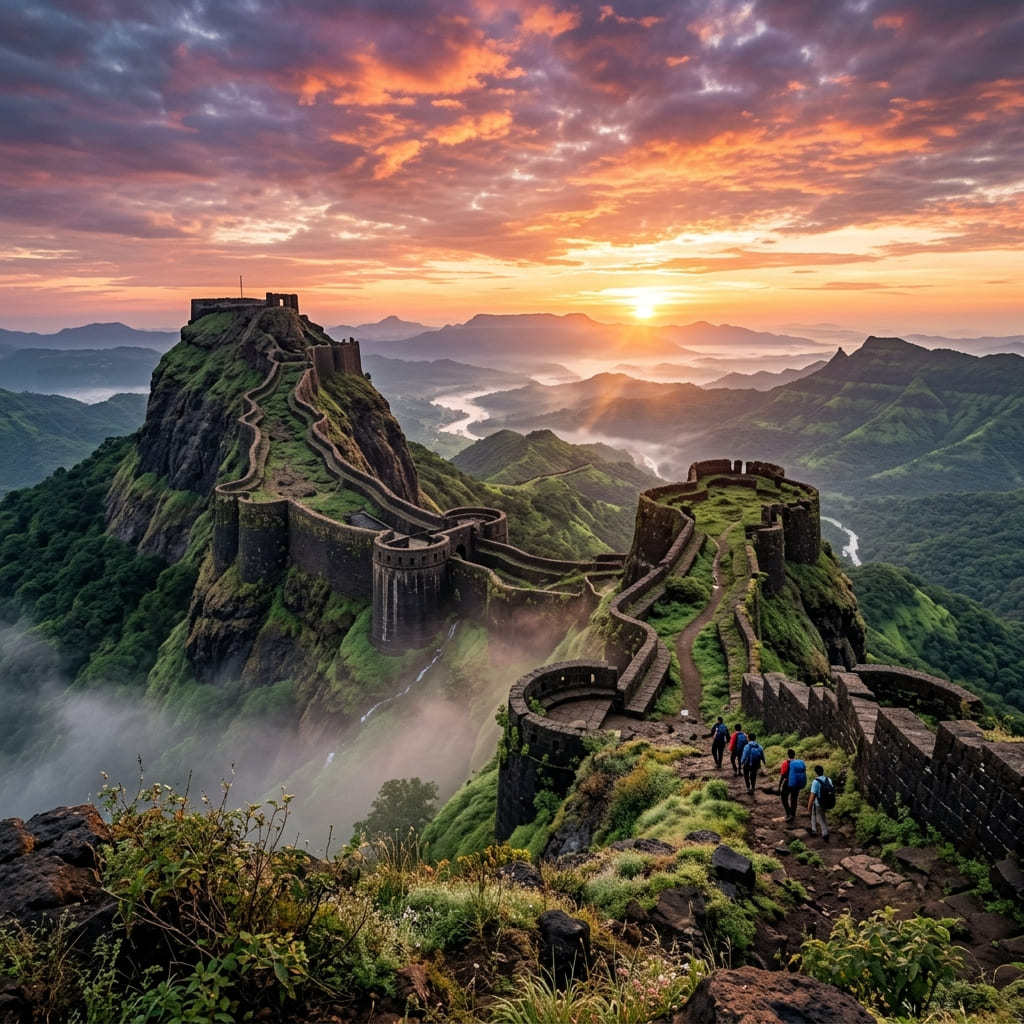
How many forts are there in Maharashtra?
Maharashtra has more than 350 forts, making it the state with the highest concentration of forts in India. These range from Sahyadri hill forts and Konkan sea forts to Deccan plateau fortifications.
Which Maharashtra forts have been recognized by UNESCO?
In 2024, UNESCO inscribed the “Maratha Military Landscapes of India” as a World Heritage Site. The designation covers 11 forts in Maharashtra—including Raigad, Rajgad, Shivneri, Torna, Lohagad, Pratapgad, Sindhudurg, Panhala, and others—alongside one fort in Tamil Nadu.
Which fort is the birthplace of Chhatrapati Shivaji Maharaj?
Chhatrapati Shivaji Maharaj was born at Shivneri Fort, near Junnar in Pune district, on February 19, 1630.
What was the first fort captured by Shivaji Maharaj?
Torna Fort (also known as Prachandagad) in Pune district was the first fort captured by Shivaji Maharaj, in 1646, when he was just 16 years old.
Which Maharashtra fort is unconquered?
Murud-Janjira Fort, controlled by the Siddi dynasty, was never captured—despite multiple attempts by the Marathas, Portuguese, and British. It remains one of the only sea forts in India with this distinction.
Which forts in Maharashtra are best for beginner trekkers?
Tikona Fort, Korigad Fort, Lohagad Fort, and Sinhagad Fort are well-suited for beginner and intermediate trekkers. All have well-marked trails, manageable elevation gains, and are accessible from Pune or Lonavala.
Is there an entry fee for Maharashtra forts?
Entry fees for most Maharashtra forts are minimal or free. Forts maintained by the Archaeological Survey of India (ASI), such as Daulatabad, charge a nominal fee. Raigad Fort’s ropeway is ticketed separately. It is recommended to check individual fort or ASI websites for current pricing before visiting.
Which Maharashtra fort offers the most dramatic view?
Harishchandragad’s Konkan Kada—a sheer overhanging cliff face with a near-vertical 1,000-foot drop—is widely considered the most dramatic viewpoint in Maharashtra. Raigad, Torna, and Rajgad also offer exceptional panoramic views.
Leave a Reply