
Crochet Patterns for Beginners: The Complete Starter Guide
New to crochet and not sure where to begin? This guide covers everything you need to get started from the supplies you’ll need and the stitches worth learning first, to six beginner-friendly crochet patterns that actually make sense for someone just picking up a hook. You’ll also find tips for reading patterns, a breakdown of common mistakes, and the best free resources to find your next project.
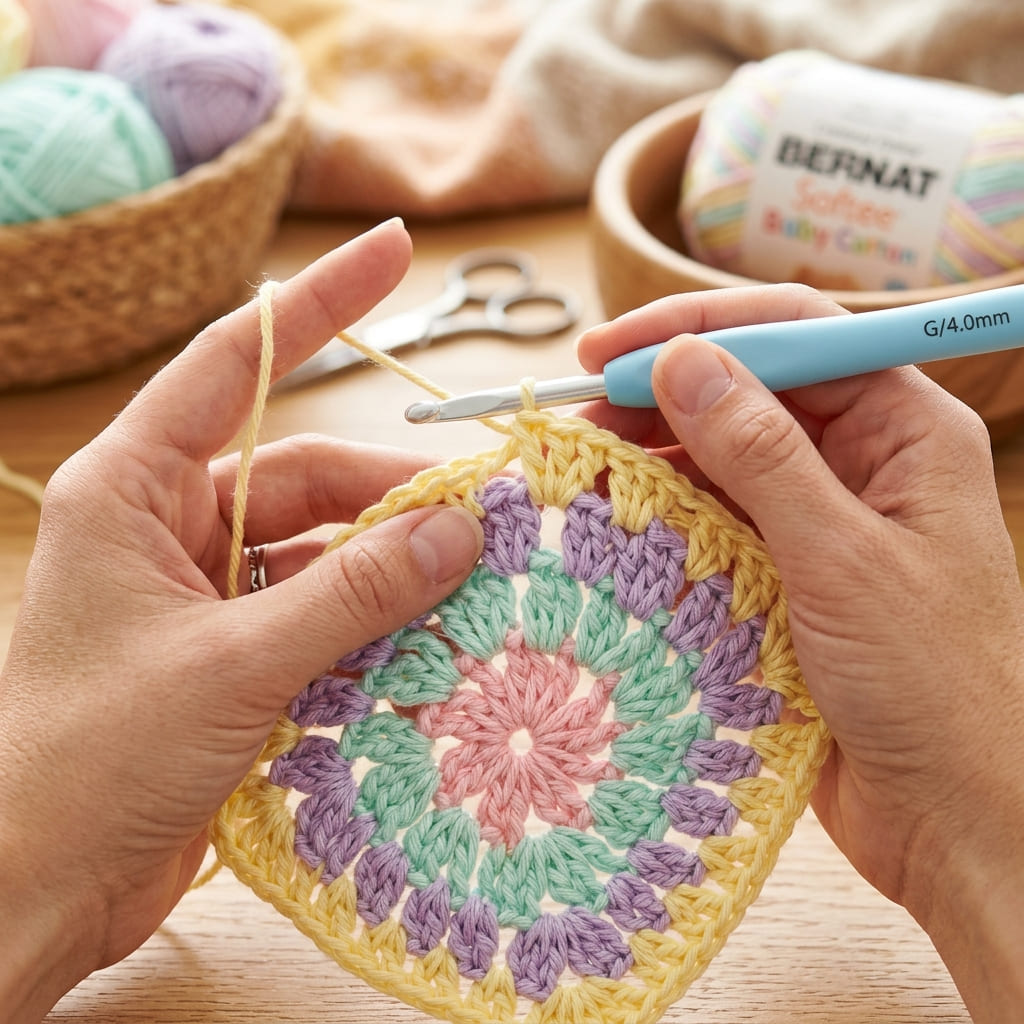
Key Takeaways
- You only need two things to start crocheting: yarn and a hook. A basic starter setup costs as little as $6.
- The four foundational stitches chain, single crochet, half double crochet, and double crochet are the building blocks of nearly every beginner pattern.
- Dishcloths, scarves, granny squares, coasters, baby blankets, and beanies are the best first projects for new crocheters.
- A study published in the British Journal of Occupational Therapy found that 81% of crocheters feel happier after crafting, and 75% report reduced stress.
- Free patterns are widely available on platforms like Ravelry, Yarnspirations, and LoveCrafts.
Why Crochet Is a Great Hobby for Beginners
Crochet is one of the most accessible crafts you can pick up. The upfront cost is low, the learning curve is gentle, and the results a finished scarf, a cozy blanket, a handmade gift are deeply satisfying.
There’s also a growing body of research behind why it feels so good. A study published in the British Journal of Occupational Therapy, which surveyed over 8,000 crocheters, found that 81% reported feeling happier when they crocheted and 75% said it helped reduce stress. The repetitive hand movements involved in crochet activate what Harvard Medical School researcher Dr. Herbert Benson called the “relaxation response” the same physiological state triggered by yoga and meditation. Heart rate slows. Cortisol drops. The mind settles.
Research published in Frontiers in Psychology supports this further, showing that the rhythmic, repetitive nature of crochet has a measurable calming effect on the nervous system. And according to the Mayo Clinic, engaging in creative crafts like crochet may also help protect against cognitive decline over time.
Beyond the science, crochet is portable, flexible, and endlessly creative. You can work on a project during a commute, while watching TV, or during a quiet morning before the house wakes up.
What Essential Crochet Supplies Do Beginners Need?
The short answer: yarn and a hook. That’s genuinely all you need to start. A basic setup costs around $6. A more complete beginner kit including a tapestry needle, stitch markers, and scissors runs about $19 if you buy items separately, or less with a bundle.
Here’s a breakdown of what each tool does:
|
Supply |
Purpose |
Beginner Tip |
|---|---|---|
|
Yarn |
The main material of every project |
Start with medium weight (worsted, size 4) acrylic yarn |
|
Crochet hook |
Used to pull loops of yarn through each other |
A 5.5mm or 6mm hook pairs well with worsted yarn |
|
Tapestry needle |
Weaves in loose yarn ends when you finish |
Look for a set with different eye sizes |
|
Stitch markers |
Marks specific stitches so you don’t lose count |
Especially useful when crocheting in the round |
|
Scissors |
Cuts yarn cleanly |
Any sharp pair works fine |
|
Tape measure or ruler |
Helps you check your gauge |
Essential for garments; optional for casual projects |
What yarn should a beginner use?
Acrylic yarn in a medium or worsted weight (labeled size 4) is the best choice for beginners. It’s affordable, easy to work with, machine washable, and available in every color imaginable. Popular options include Lion Brand Vanna’s Choice, Red Heart Soft, and Red Heart Super Saver.
Yarn weights run from 0 (lace) to 7 (jumbo). Beginners should avoid the extremes lace weight is too thin and fiddly, while jumbo yarn can be hard to control. Worsted weight hits the sweet spot.
What hook size should a beginner start with?
Match your hook size to the yarn label’s recommendation. For most worsted weight yarns, that’s a 5.5mm or 6mm hook. Aluminum and plastic hooks are affordable and widely available. Ergonomic hooks which have a cushioned grip are worth considering if your hands tire quickly or if you plan to crochet for long stretches.
What Are the Basic Crochet Stitches Beginners Should Learn First?
Every crochet pattern is built from a small handful of stitches. Master these six, and you’ll be equipped to tackle nearly any beginner-level project.
Chain Stitch (ch)
The chain stitch is the starting point for almost every crochet project. It forms the foundation chain the base row from which you’ll build your work. It’s also used for turning chains at the beginning of rows and for decorative purposes in more complex patterns.
Slip Stitch (sl st)
Slip stitches don’t build height they’re used to join rounds, move yarn across stitches without adding fabric, and finish off a project. You’ll see them constantly in pattern instructions.
Single Crochet (sc)
Single crochet is the smallest and densest of the main stitches. It creates a tight, sturdy fabric that works beautifully for dishcloths, coasters, and amigurumi toys. To make one, insert your hook into a stitch, yarn over, pull up a loop (two loops on hook), yarn over again, and pull through both loops.
Half Double Crochet (hdc)
Slightly taller than single crochet, the half double crochet produces a soft, dense fabric with a subtle ridge. It’s a favorite for hats and sweaters. The key difference: you yarn over before inserting the hook, leaving three loops on the hook before the final pull-through.
Double Crochet (dc)
Double crochet is roughly twice the height of single crochet and covers ground quickly, making it ideal for blankets and scarves. It’s the stitch used in classic granny squares. You yarn over before inserting the hook, draw up a loop (three loops on hook), then work off two loops at a time in two separate steps.
Treble Crochet (tr)
Also called triple crochet, this is the tallest of the basic stitches three times the height of single crochet. The extra height creates open, airy fabric well-suited for lacy patterns. You yarn over twice before inserting the hook, and work off loops two at a time across three separate steps.
|
Stitch |
Abbreviation |
Height |
Best For |
|---|---|---|---|
|
Chain |
ch |
N/A |
Foundation rows, turning chains |
|
Slip stitch |
sl st |
Minimal |
Joining, finishing |
|
Single crochet |
sc |
Shortest |
Dishcloths, coasters, amigurumi |
|
Half double crochet |
hdc |
Medium-short |
Hats, sweaters |
|
Double crochet |
dc |
Medium-tall |
Blankets, scarves, granny squares |
|
Treble crochet |
tr |
Tallest |
Lacy and open-work patterns |
What Are the Best Easy Crochet Patterns for Beginners?
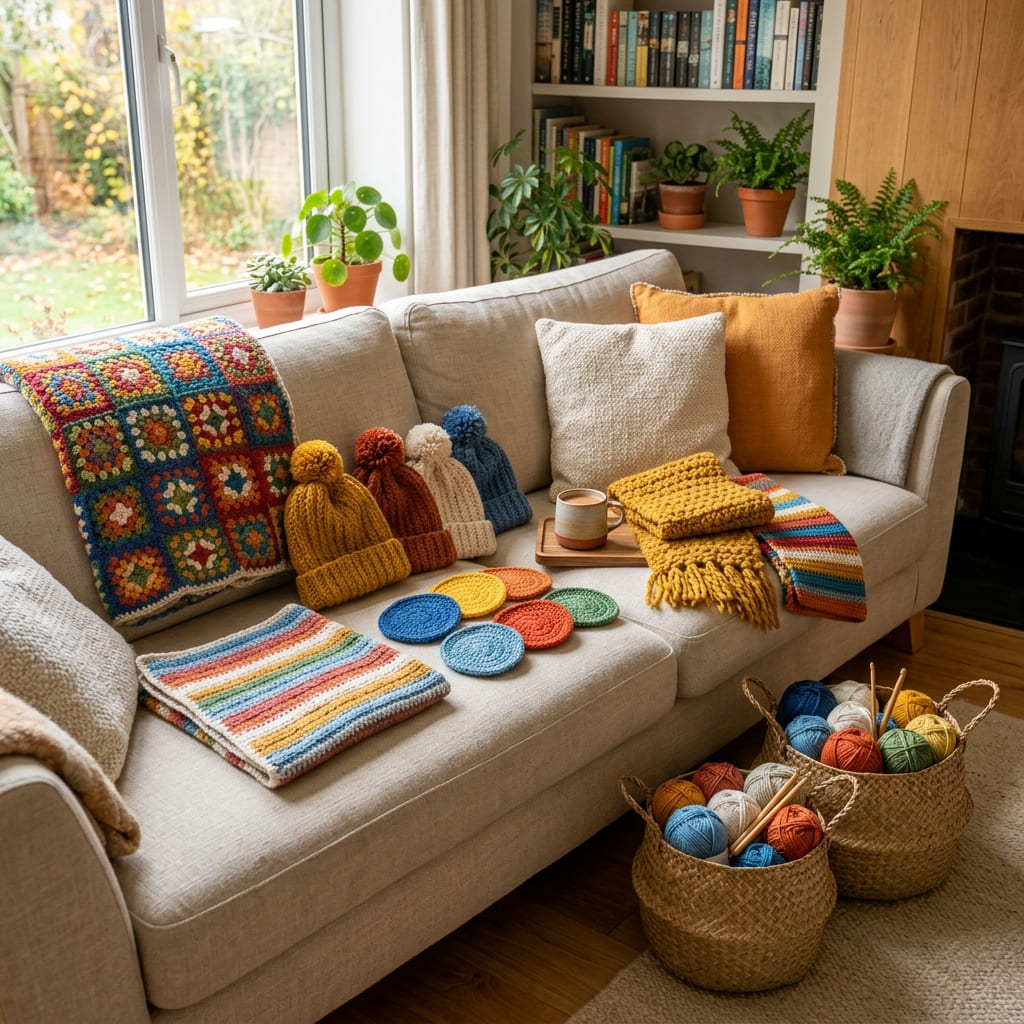
The six projects below are specifically suited to beginners each one teaches a core skill without overwhelming you with complex techniques or shaping.
1. Dishcloth
Why it’s great for beginners: A dishcloth is one of the fastest ways to practice stitching in straight rows. There’s no shaping, no joining, and no counting in the round. You start with a foundation chain, work even rows of single or double crochet back and forth, and you’re done.
It’s also forgiving. Slightly uneven tension? A dishcloth doesn’t care. By the time you finish your first one, your tension will already be more consistent than when you started.
Stitches used: Single crochet or double crochet
Estimated time: 1–2 hours
2. Scarf
Why it’s great for beginners: A scarf is just rows long, satisfying rows. No increases, no decreases, no shaping. Pick a stitch (half double crochet is especially popular for scarves), decide on your width, and repeat until you reach your desired length.
The repetition builds muscle memory fast. You’ll internalize tension, turning chains, and stitch placement simply by doing the same motion hundreds of times. Choose a chunky yarn and a larger hook if you want faster results.
Stitches used: Half double crochet or double crochet
Estimated time: 2–5 hours depending on yarn weight
3. Granny Square
Why it’s great for beginners: The classic granny square teaches you to crochet in the round a skill that opens up a huge range of projects. It uses double crochet clusters and slip stitches to build outward from a center ring.
Each square is small and quick to finish (often 20–30 minutes), which gives you regular wins. Make one square, or make dozens and join them into a blanket. Granny squares are also an excellent way to use up leftover yarn scraps.
Stitches used: Double crochet, chain, slip stitch
Estimated time: 20–45 minutes per square
4. Coaster
Why it’s great for beginners: A coaster is even smaller than a granny square and finishes in under 30 minutes. It’s an ideal first project if you want to learn in rounds rather than rows you work outward from a magic ring or foundation chain loop using single crochet.
The small scale means mistakes are easy to spot and fix. Finish a set of four and you’ll have a practical gift and a real confidence boost.
Stitches used: Single crochet
Estimated time: 15–30 minutes per coaster
5. Baby Blanket
Why it’s great for beginners: A baby blanket is essentially an extended dishcloth the same stitch repeated across a wider, longer piece. What makes it valuable as a beginner project is the gauge practice it provides. You’ll work the same stitch hundreds of times, which means your tension naturally evens out over the course of the project.
Baby blankets are also a meaningful make. They’re among the most popular handmade gifts, and the sense of accomplishment after finishing one is significant.
Stitches used: Single crochet, double crochet, or half double crochet
Estimated time: 5–15 hours depending on size and yarn weight
6. Beanie
Why it’s great for beginners: A beanie introduces you to crocheting in rounds and working decreases two skills you’ll use constantly as you progress. Most beginner beanie patterns are straightforward: you work in continuous rounds using single or half double crochet, increase at the top to shape the crown, and decrease slightly at the brim.
A basic beanie can be finished in an afternoon, and the end result is something you can actually wear.
Stitches used: Single crochet or half double crochet
Estimated time: 2–4 hours
How Do You Read a Crochet Pattern as a Beginner?
Crochet patterns have their own shorthand. Once you learn to decode it, even complex patterns become readable. Here are the key things to understand:
- Abbreviations: Patterns use standard abbreviations. Ch = chain, sc = single crochet, hdc = half double crochet, dc = double crochet, sl st = slip stitch, tr = treble crochet.
- Asterisks and brackets: Instructions inside asterisks (sc in next 3 sts, ch 1; repeat from * to end) or brackets mean you repeat that section.
- Numbers in parentheses: Usually indicate the stitch count at the end of a row or round, e.g., (24 sts).
- Turning chains: At the start of each row, patterns tell you how many chains to make before turning. This creates the right height for the stitch that follows.
- Gauge: Many patterns specify how many stitches and rows should fit into a 4″x4″ square. For fitted projects like garments, matching gauge matters. For blankets and scarves, you have more flexibility.
What Are the Most Common Beginner Crochet Mistakes and How Do You Fix Them?
Every beginner makes these mistakes. Knowing what to watch for can save you a lot of frustration.
- Tension that’s too tight or too loose: Tight tension makes stitches hard to insert your hook into; loose tension leaves gaps. The fix is practice but also checking that your hook size matches the yarn label’s recommendation.
- Losing stitch count: Rows that get wider or narrower usually mean you’ve accidentally added or missed stitches. Use stitch markers to track the first and last stitches of each row.
- Missing the last stitch: The final stitch in a row is often hidden under the turning chain. Look carefully and count before moving on.
- Skipping the gauge swatch: For blankets and dishcloths, gauge matters less. For hats, sweaters, or anything fitted, always make a small swatch first and adjust your hook size as needed.
- Not weaving in ends: Loose yarn tails will unravel over time. Use your tapestry needle to weave ends through several stitches before trimming.
- Starting with yarn that’s too thin: Lace weight or fingering weight yarn is beautiful but extremely difficult to work with as a beginner. Stick with worsted weight until you’re comfortable.
Where Can Beginners Find Free Crochet Patterns?
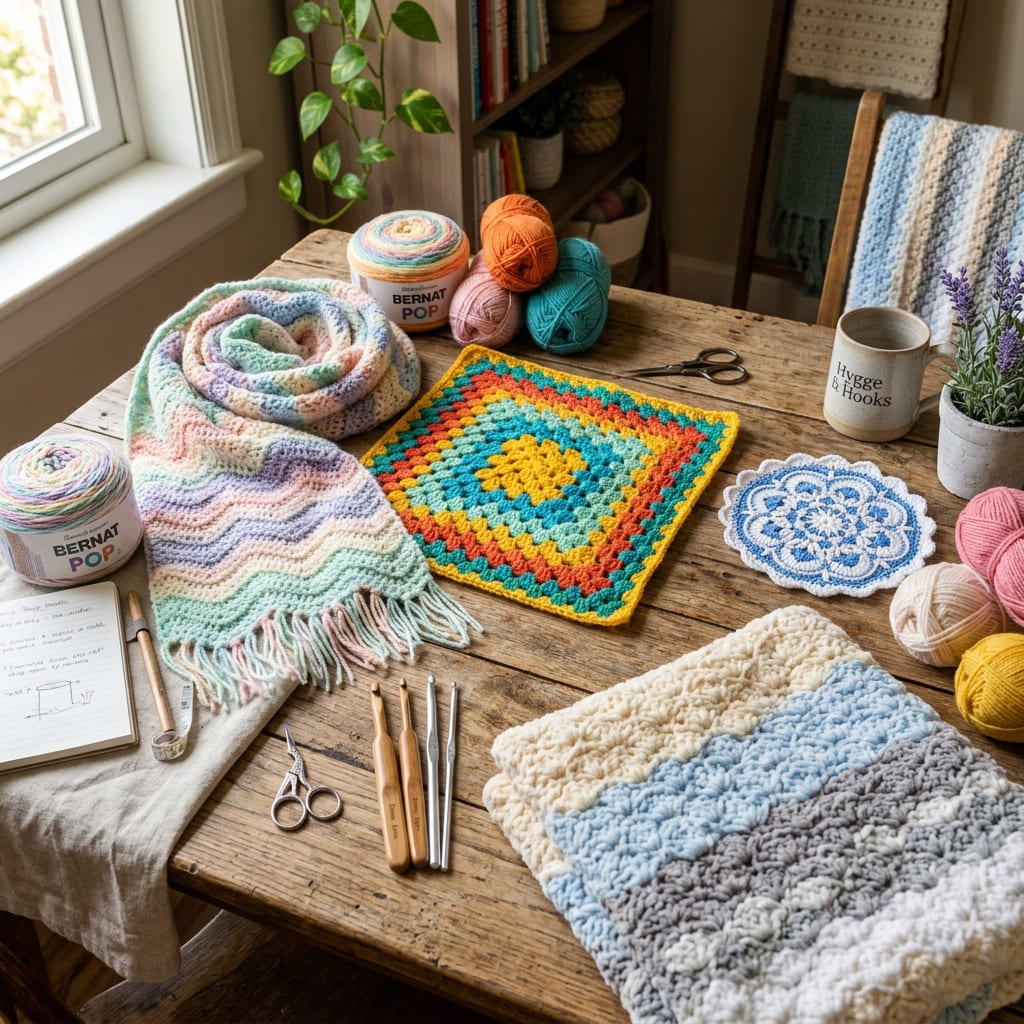
These platforms are the most reliable sources for free, high-quality beginner crochet patterns:
- Ravelry (ravelry.com): The largest pattern database for knitters and crocheters. You can filter by skill level, stitch type, yarn weight, and project category. Many patterns are free to download.
- Yarnspirations (yarnspirations.com): A massive library of free patterns from major yarn brands like Bernat, Caron, and Patons. The beginner filter makes it easy to find suitable projects.
- LoveCrafts (lovecrafts.com): Thousands of free crochet patterns across all categories, from baby items to home décor.
- Easy Crochet (easycrochet.com): Beginner-focused tutorials and patterns with clear step-by-step photos and videos.
- Lucy Kate Crochet (lucykatecrochet.com): Excellent written and visual guides for foundational techniques and beginner projects.
- Sigoni Macaroni (sigonimacaroni.com): A beginner-friendly blog with a structured “Learn to Crochet the Easy Way” series and free downloadable patterns.
Frequently Asked Questions About Crochet for Beginners
How long does it take to learn basic crochet stitches?
Most beginners can learn a single basic stitch like the chain or single crochet within 30 minutes to an hour with a good tutorial. Mastering all six foundational stitches typically takes a few days to a week of regular practice, not months.
What is the easiest crochet pattern for an absolute beginner?
A dishcloth or coaster is generally considered the easiest starting point. Both are small, use simple straight rows or basic rounds, and require only single or double crochet. They’re also quick to finish, which gives beginners an early sense of accomplishment.
What size crochet hook should a beginner use?
A 5.5mm or 6mm hook is the most commonly recommended size for beginners, paired with medium-weight (worsted, size 4) yarn. This combination is easy to control and produces visible stitches that are straightforward to count and correct.
Is crochet easier than knitting to learn?
Most beginners find crochet slightly easier to pick up than knitting. Crochet uses a single hook rather than two needles, and each stitch is completed individually before moving to the next making it easier to spot and fix mistakes without the project unraveling.
How much does it cost to start crocheting?
A bare-bones setup one skein of yarn and a single hook costs around $6. A more complete beginner kit including a tapestry needle, stitch markers, and scissors runs approximately $19 when purchased separately, or less with a bundled beginner set.
Can I learn to crochet from written instructions alone, or do I need video tutorials?
Many people learn successfully from written patterns alone, but video tutorials can be invaluable for understanding the physical motion of each stitch. Platforms like YouTube have thousands of free beginner crochet videos. A combination of written instructions and video is often the most effective approach.
What’s the best yarn for a beginner crocheter?
Worsted weight acrylic yarn is the best choice for beginners. It’s affordable, easy to handle, available in a wide range of colors, and machine washable. Well-regarded beginner options include Lion Brand Vanna’s Choice, Red Heart Soft, and Red Heart Super Saver.
Your First Stitch Is the Hardest One
The biggest obstacle most beginners face is starting. Once you have yarn and a hook in hand, the rest follows stitch by stitch. Start with a dishcloth or a coaster something small with a quick finish and build from there.
The six projects in this guide are specifically chosen to teach you real skills without requiring complicated techniques or expensive materials. A dishcloth teaches straight rows. A granny square teaches working in the round. A beanie introduces shaping. Each project moves you forward.
Head to Ravelry, Yarnspirations, or LoveCrafts and search for a free beginner pattern that catches your eye. Pick up some worsted weight yarn and a 5.5mm hook. And give yourself permission to make something imperfect on the first try because that’s exactly how every experienced crocheter started.
Leave a Reply